The Wi-Fi alliance started the Wi-Fi6 certification program in late 2018. Wi-Fi6 is based on IEEE’s 802.11ax standard which has introduced many PHY and MAC level efficiency improvements such as
- 1/4 Sub-carrier spacing
- 1024 QAM (MCS 11)
- Upto 8 spatial Streams
- OFDMA (Downlink and Uplink)
- MU-MIMO (Downlink and Uplink)
- BSS coloring
- Target Wake-up Time
In this blog, I would like to discuss the efficiency benefits of reduced carrier spacing in Wi-Fi6, which increases PHY rates at all MCS index. One fundamental change in 802.11ax standard is the 1/4 reduction in OFDM subcarrier spacing from the 802.11ac standard (that’s now called Wi-Fi5).
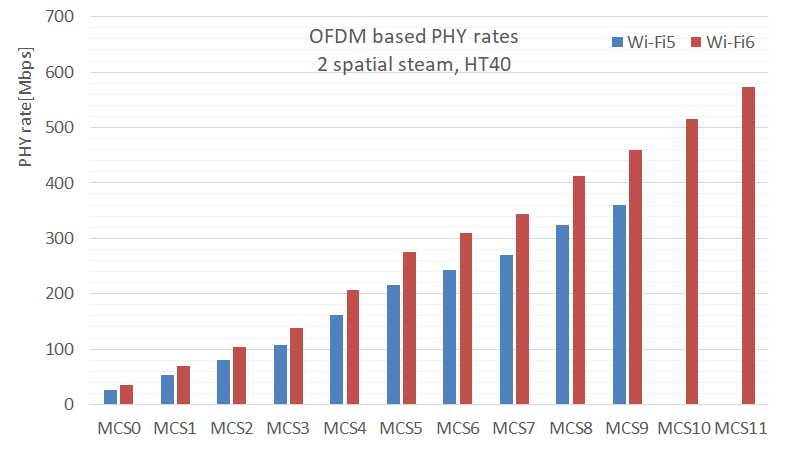
I referred to the blog to create a plot of Wi-Fi6 vs Wi-Fi5 PHY rates for all MCS rates. Note that MCS10/11 are not available in Wi-Fi5.
One can argue over the inverse relation between sub-carrier spacing and symbol length which should nullify any throughput benefits.
Symbol length= 1/(Subcarrier spacing)
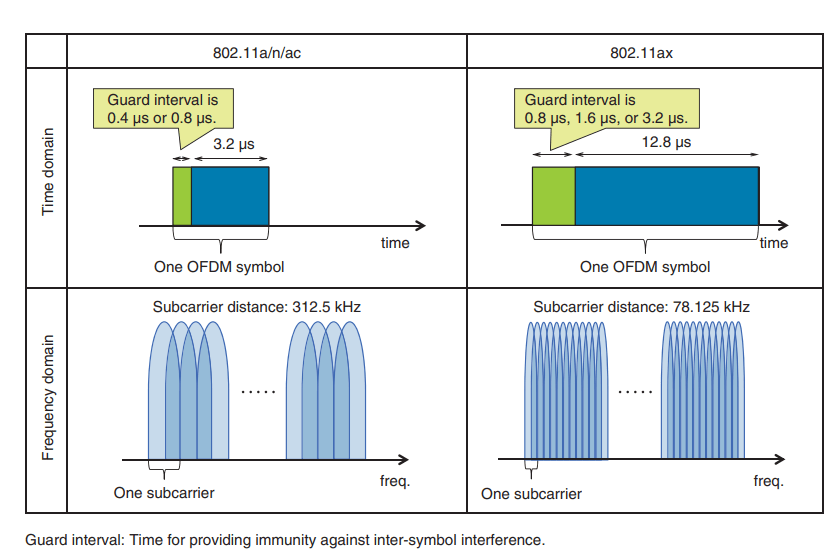
So Wi-Fi6 symbols are longer but provide higher PHY rates?
The key is to look at the duration of the guard interval and the number of data subcarriers. Guard interval are added at the beginning of every Wi-Fi symbol to protect the symbol from channel impairments like Inter Symbol Interference(ISI) caused by reflections from objects and walls. This can be quantified by ‘delay spread‘ which is a measure of the multipath effects. In a typical home, delay spread is between 50-100 nsec, so a 0.8 usec GI is an optimum choice.
OFDM channel efficiency = (Symbol length/(Symbol length+GI))
Wi-Fi5= (3.2/ (3.2+0.8))= 0.8
Wi-Fi6 = (12.8/(12.8+0.8))= 0.941
An increase of 17.625% or 1.176 over Wi-Fi5
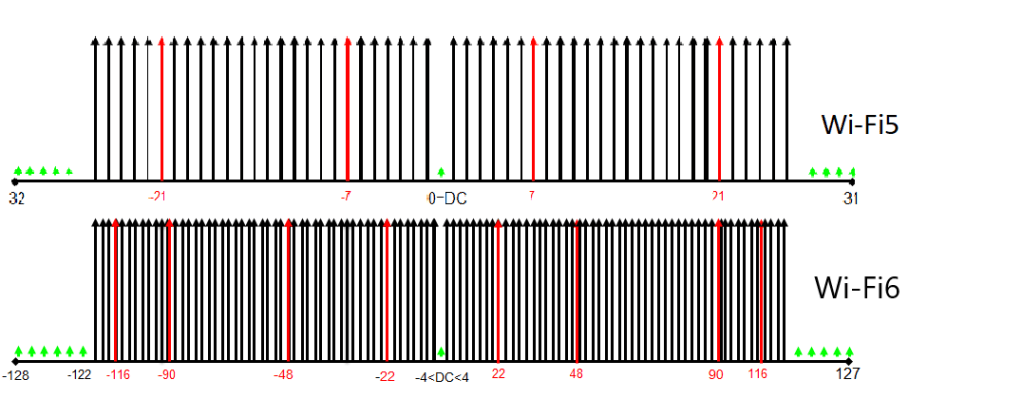
The second improvement is in the number of data sub-carriers in Wi-Fi6 standard. For a 20 MHz operational bandwidth, the number of data subcarriers has increased from 52 in Wi-Fi5 to 234 in Wi-Fi6, which is more than 4 times the number of sub-carriers on which data can be transmitted.
Wi-Fi5 data subcarrier utilisation: (52/64) = 0.8125
Wi-Fi6 data subcarrier utilisation: (234/256)= 0.9140
An increase of 12.492% or 1.125 over Wi-Fi5
The compounding effects of OFDM channel efficiency and data subcarrier utilization gives an overall
(1.176*1.125-1) = 32.30% improvement in Wi-Fi6 rates over Wi-Fi5
This is one of the most fundamental benefits of Wi-Fi6 which should improve Wi-Fi coverage in our homes.
Stay tuned to learn about 1024 QAM aka MCS11 feature of Wi-Fi6 in my next blog post. Your comments are very welcome!
| Abbreviation | Explanation |
| OFDM | Orthogonal Frequency Division Multiplexing |
| MAC | Medium Access Control |
| QAM | Quadrature Amplitude Modulation |
| MCS | Modulation and Coding scheme |
| OFDMA | Orthogonal Frequency Division Multiple Access |
| PHY | Physical Layer |

 Sarodeoverwireless Consulting
Leave a comment