In my last blog, we talked about the throughput gains due to efficiency improvements in PHY layer of Wi-Fi6. I wanted to follow up with some discussions on hardware challenges and practical benefits of 1024 QAM (aka MCS 11) in this blog, but I think it is good to discuss the impact of Wi-Fi MAC layer which gives a more realistic picture on throughput gains with Wi-Fi6 standard.
Let’s start with a simple scenario of a Wi-Fi router performing a downlink data communication to a Wi-Fi client/STA.
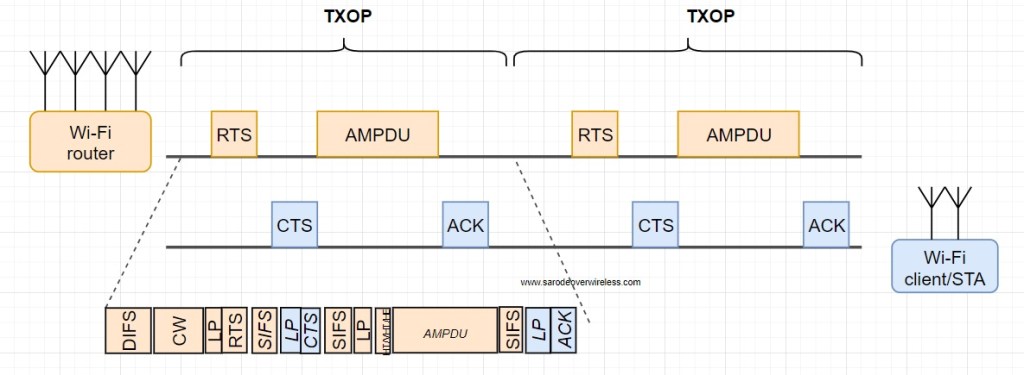
RTS/CTS is a widely adopted 802.11 protection mechanism, which was created to avoid the race condition among multiple clients due to “Hidden Node problem“. In the downlink scenario, the Wi-Fi router sends a Request to send (RTS) message to the Wi-Fi client. The client responds with a Clear to Send (CTS) message. Now the Wi-Fi router can send data packets (in aggregated MPDU format) to the client. The client then sends back an Acknowledgement (ACK) frame to acknowledge the faithful reception of these data packets. All these events occur within an event called Transmit Opportunity (TXOP).
For every data packet sent over the air, there is an overhead of 3 management frames (RTS/CTS/ACK), Inteframe spacing (DIFS/SIFS) and Contention Window (CW). Also note that the management frames are usually sent at lower MCS rate (MCS index 0 – 4) and mostly sent as NON_HT or legacy format to reduce the airtime
Non-HT or Legacy = 802.11 a/b/g/n
VHT or Wi-Fi5 = 802.11 ac
HE_SU or Wi-Fi6 = 802.11 ax
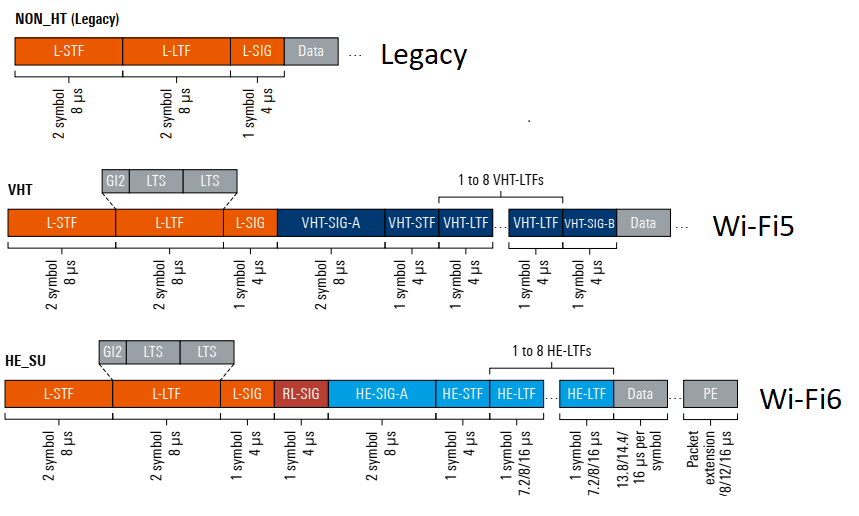
You can quickly observe that HE_SU or 802.11 ax has a large preamble overhead (will explain them another time, promise!). Recently, I came across another great blog while looking for Wi-Fi airtime calculations. I borrowed the MAC overhead numbers from Gjermund’s wonderful calculator.
| Airtime [usec] | DIFS | CW | LPX3 | SIFSx3 | RTS | CTS | ACK |
| non HT@MCS 4 | 43 | 72 | 20 | 16 | 8 | 8 | 16 |
Typical Wi-Fi overhead: 255 usec
Now let look at how data packets are sent over Wi-Fi link. Wi-Fi standard mandates overheads in the form of preambles, contention windows and waiting time for backward compatibility and good neighbor behavior with other Wi-Fi clients. Frame aggregation was introduced in the 802.11e standard to improve Wi-Fi efficiency. Data as large as 1 MB can be packed in an aggregated data frame AMPDU. I used MCS 9 index to calculate the airtime for different payload sizes for Wi-Fi5 and Wi-Fi6 standard.
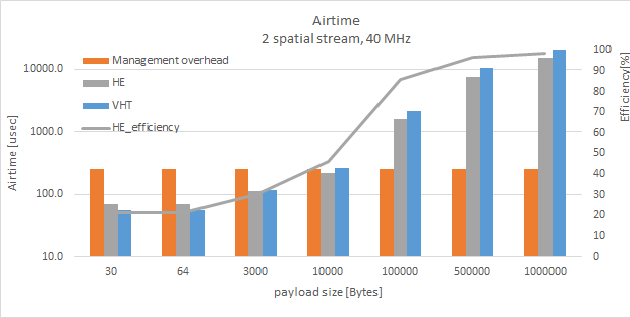
In conclusion, Wi-Fi6 aka HE packet transmission takes less airtime than VHT data packets for larger payload size (> 3 KB). For smaller payload size (< 3 KB), Wi-Fi5 aka VHT packets are more efficient. The throughput efficiency of Wi-Fi6 goes up with larger payload distribution. Remember this airtime analysis is for a single client scenario and airtime will become larger when more clients are trying to talk at the same time. OFDMA has potential to ameliorate airtime loss due to overhead and contention, but that another large topic to discuss.
I sincerely hope you were able to learn something today. Please do not hesitate to send in your comments (good, bad or ugly). All are welcome!

 Sarodeoverwireless Consulting
Leave a comment