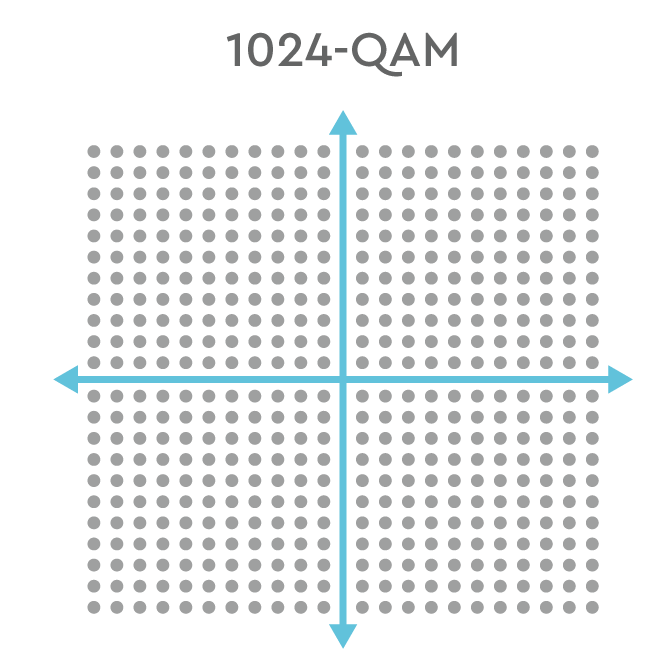
Error Vector Magnitude (EVM) is a single most important performance metric of Wi-Fi systems, which gives a comprehensive indication of the quality of the Wi-Fi hardware. The transmitter chain silicon design; RF Front End(RFFE) components (filters, power amplifiers, matching and diplexers) and antennas, all add noise to the Wi-Fi system. Measuring EVM will tell you how good your Wi-Fi hardware is and most importantly, help you pass the Wi-Fi alliance certification.
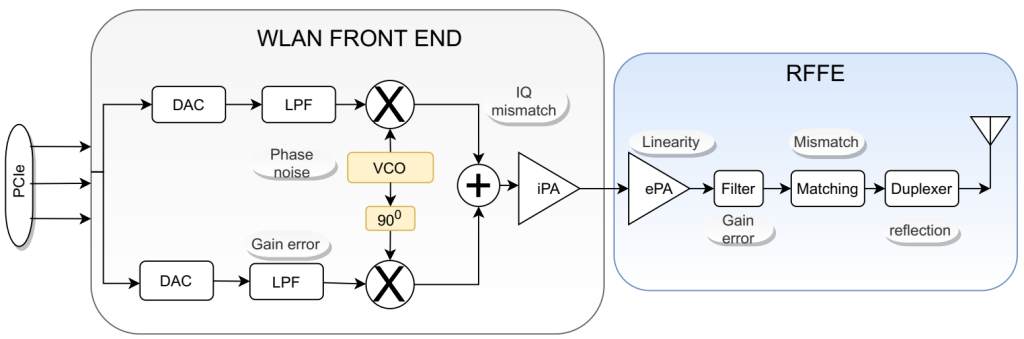
Let’s go into the nuts and bolts of Wi-Fi packet generation to understand why EVM is so important.
Data generated from the higher layers get transformed to the analog domain by a Digital to Analog Converter (DAC). The analog signal then passes through filters, mixers and then sent over the air after amplification by a Power amplifier (i/ePA). Wi-Fi radios use Quadrature Amplitude Modulation (QAM) digital modulation technique to encode multiple bits of data (Wi-Fi6 MCS 11 does 10 bits per symbol!) into symbols. Quadrature means that the symbols have an amplitude and a phase component (also two degrees in which noise can be added). The yellow dots in the constellation diagram below are symbols encoded with 1024 QAM.
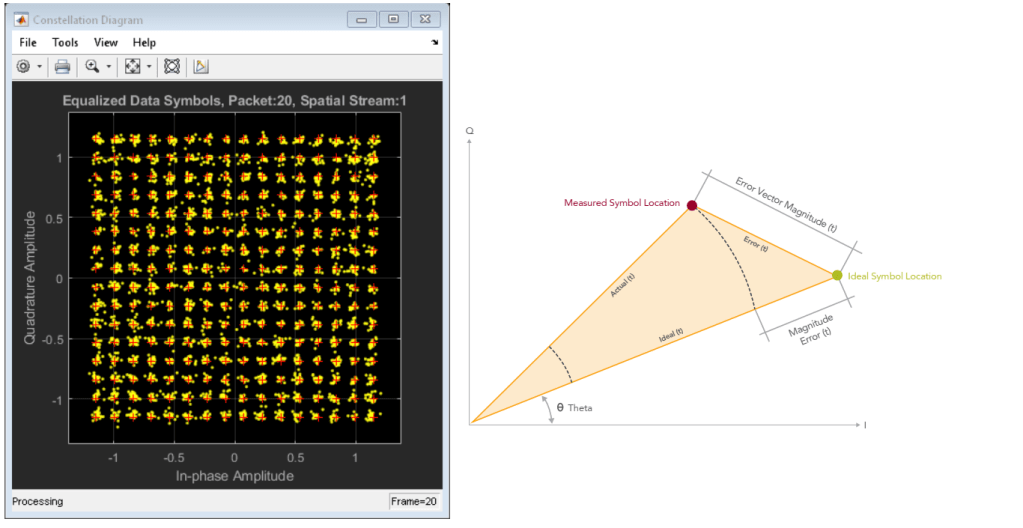
EVM is a measure of the deviation of the encoded symbol (in red) from the reference (in green). The EVM measured per symbol is averaged over multiple OFDM subcarriers and represented either in percentage or in dB (most popular). The table below gives maximum EVM limits per MCS index that must be supported by a Wi-Fi6 radio.
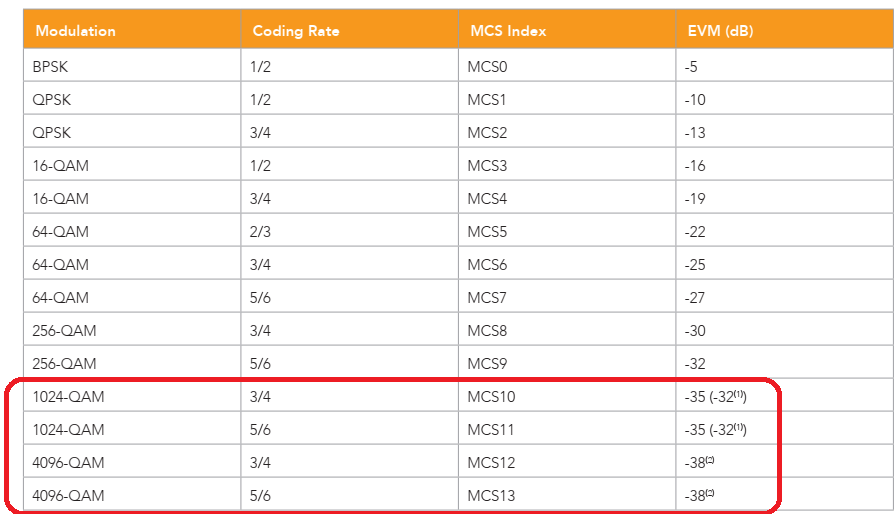
Note that 1024QAM or MCS11 index in Wi-Fi6 allows an error of only 1.8% ! The Wi-Fi silicon along with the RFFE have to be designed to minimize amplitude/phase noise contributions by the individual components of the transmit chain (see the block diagram of a typical transmitter above).
Now that we have covered what is the EVM part, let look at how it can be measured. Wi-Fi hardware design houses use test equipment like Litepoint to measure the EVM performance. The Wi-Fi hardware uses a special test firmware to interact with such test equipments. Such type of testing can be called “white box” testing as the user has fine control on the working of the Wi-Fi system. White box testing are great for debug and testing hardware quality during production. They do have some pitfalls. White box testing are not done with production firmware and with real Wi-Fi packets (also no MIMO).
In this blog, I would like to show a concept “black box” type testing (fully conducted), which can be used to measure EVM on multiple streams. Iperf can create a TCP/UDP traffic between the AP and client. A Butler matrix can be used to artificially create phase delays between the 8 spatial streams for MIMO communication. A variable attenuator will induce MCS index drop by reducing the AP’s signal level at the Wi-Fi client.
The over the air traffic will be captured by a spectrum analyzer in I/Q format. A signal processing tool like Matlab WLAN toolbox[1] can do very advanced signal processing on these packets to measure EVM per packet per spatial stream.
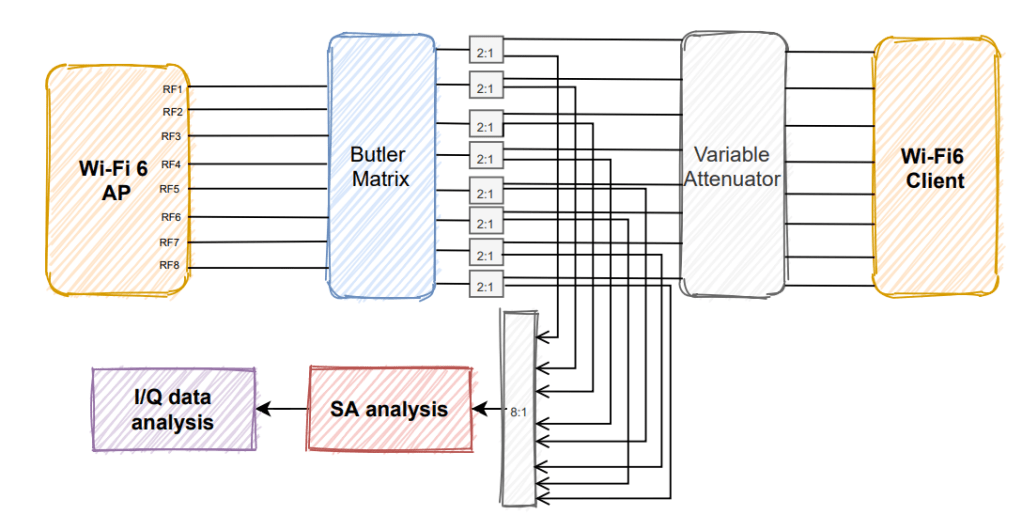
It doesn’t just stop at measuring EVM! Once you got the I/Q data, you can measure other Wi-Fi performance parameters like Carrier Frequency Offset(CFO), Spectral mask/flatness, etc.
Hope my blog helps you to effectively build and qualify your next Wi-Fi6 hardware!
[1] Litepoint whitepaper- EVM: Why it matters and how it’s measured
[2] https://nl.mathworks.com/help/wlan/ug/802-11ac-transmitter-measurements.html
MCS: Modulation Coding Scheme

 Sarodeoverwireless Consulting
Leave a comment