
Recently, the Wi-Fi Alliance launched a certification program called Wi-Fi Quality of Service (QoS) Management which is a major update to the very popular Wi-Fi Multimedia (WMM). The WMM program was launched in 2004 to improve the user experience of audio/video streaming over Wi-Fi by creating 4 medium access categories – Audio, Video, Best Effort and Background traffic, with audio having the highest priority to medium access.
WMM enabled Wi-Fi devices continuously monitor the Differentiated Services Code Point (DSCP) QoS marking in the IPV4/6 header of data packets; map it to the User Priority (UP) marking used for MAC level arbitration and then finally to the wireless medium access prioritization scheme as depicted below.
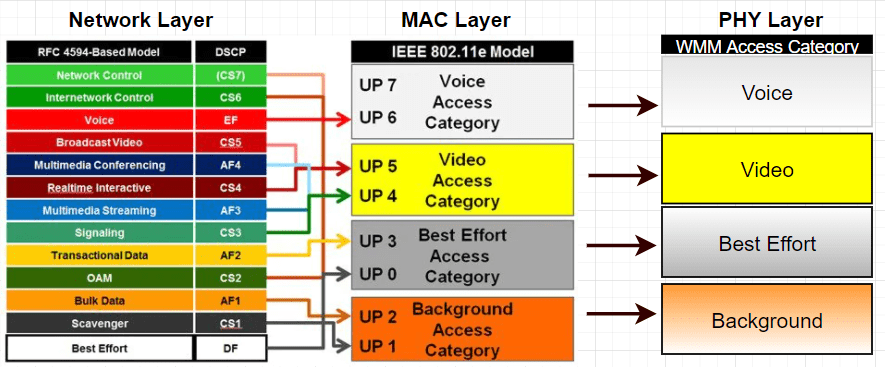
Source: https://www.cisco.com/c/en/us/td/docs/wireless/controller/8-1/Enterprise-Mobility-8-1-Design-Guide/Enterprise_Mobility_8-1_Deployment_Guide/ch5_QoS.html
In managed Wi-Fi systems (office/public Wi-Fi), it is very common for IT administrators to add DSCP marking to the IP packets and have a defined WMM mapping table on the access points. They are able to reliably prioritize applications like Zoom or Webex over other internet traffic.
The situation for internet data coming to our homes is different. You may have heard about the discussions on net neutrality which has kept are internet open, fair and free from any vendor influence. It was the right thing to do, but it has hampered the practical implementation of QoS in residential Wi-Fi deployments.
To understand this dilemma, lets consider an example of an online multi-player application on a tablet which demands low latency and high video fidelity. The gaming application on the tablet requests for data from the internet (equivalent to a server). The server adds a priority marking of ‘AF4-multimedia video distribution‘ in the DSCP field of the IP packet. This packet flows through your Internet Service Providers (ISP) cabled network (CMTS) who are enforced to remark the DSCP priority of all incoming IP packets to ‘0000-Background Traffic’. The Broadband router (being oblivious to this remarking) sends gaming packets on lowest priority (a.k.a. background traffic). Wi-Fi vendors have tried to solve this problem by building their own proprietary QoS Packet marking algorithm, which identifies the data stream and then maps the User Priority to WMM. These have been benchmarked in many studies/blogs and has not been very effective (smallnetbuilder blogs).
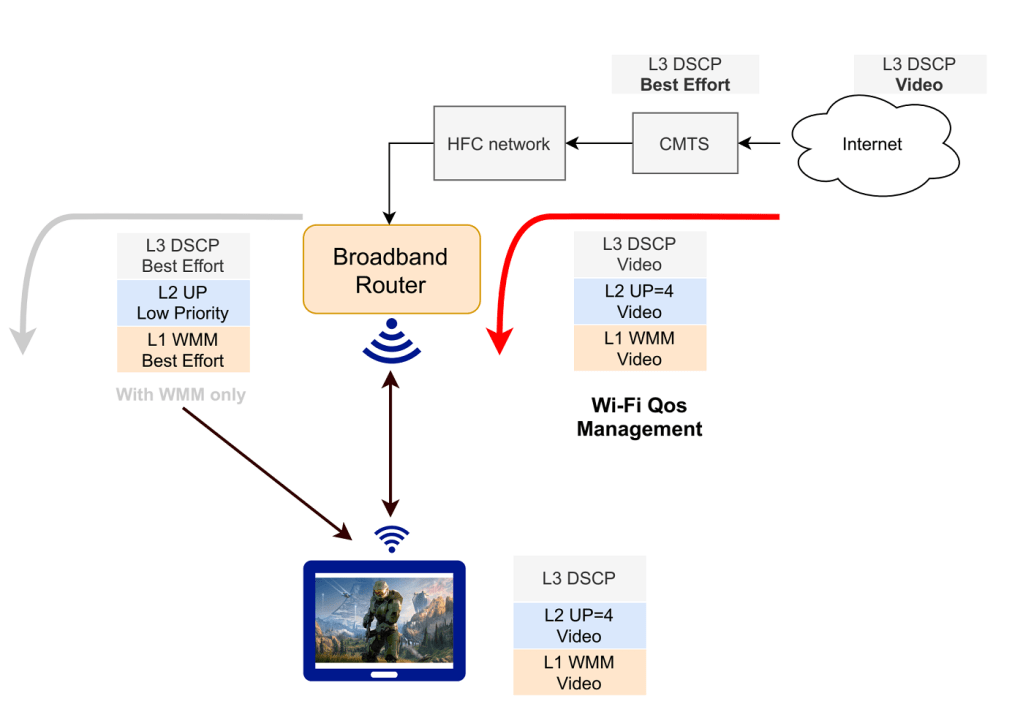
With the latest QoS Management program from Wi-Fi alliance, the Broadband router and tablet uses the Mirror Stream Classification Service feature (MSCS) to implement a QoS scheme. When the gaming application is invoked on the tablet, it presents its desired User Priority scheme to the router. The router, based on its capabilities, will either fully mirror the priority scheme for all future downlink packets to the gaming application on the tablet or negotiate a lower priority based on its UP mapping table. Thus, the router is able to assign a priority to all incoming packets by ‘mirroring’ its client QoS requirements.
So next time you are buying a tablet or a laptop, do check if the device is certified for the Wi-Fi QoS Management.
References:

 Sarodeoverwireless Consulting
Leave a comment