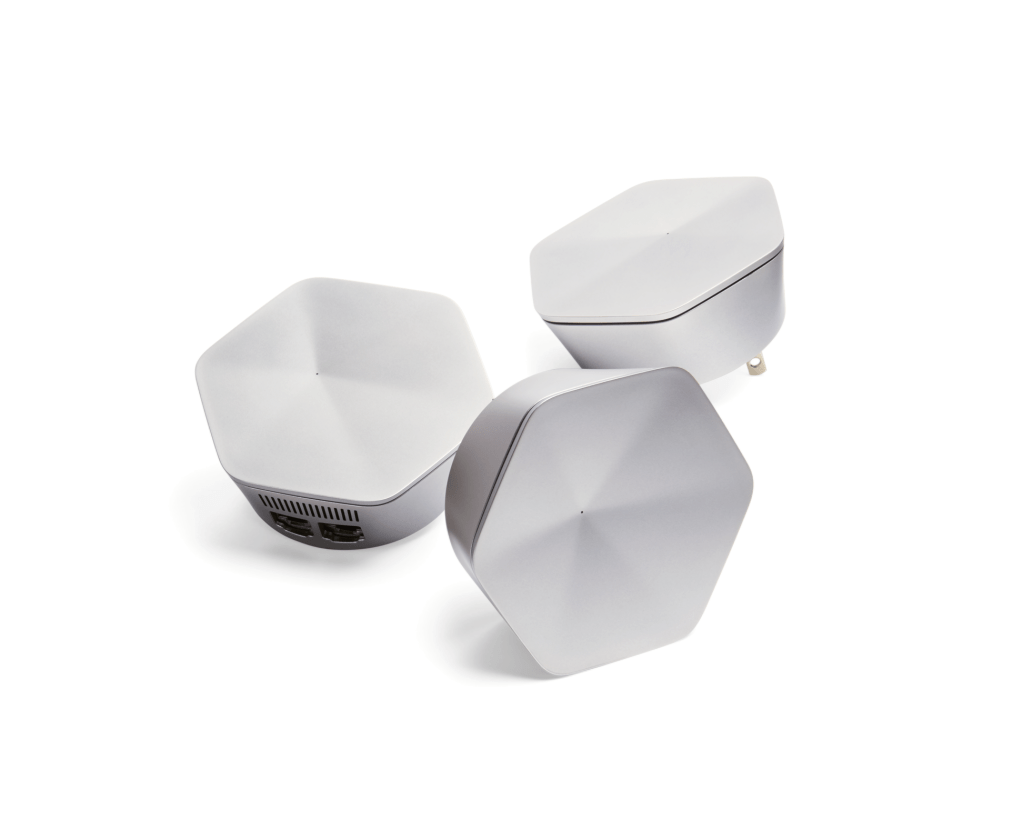
Recent discussions on latency management of a Wi-Fi network with an industry expert (Magnus Olden, Domos) led me to revisit my previous blog post in which I had compared latency, jitter, and packet loss data of my standalone AP with a Wi-Fi mesh system. The time domain graphs showed visual improvements in latency, jitter, and packet loss with Wi-Fi mesh APs. The plots made it difficult to quantify these perceived improvements, so I turned to basic statistical analysis to gather more insights.
I have used the same data set to create cumulative distribution function (CDF) plots for latency, jitter, and packet loss to better understand the improvements seen in our home with the Wi-Fi mesh system. Revisit the mesh system setup in our home.
Ping Round Trip Time Latency – 24 hours measurement
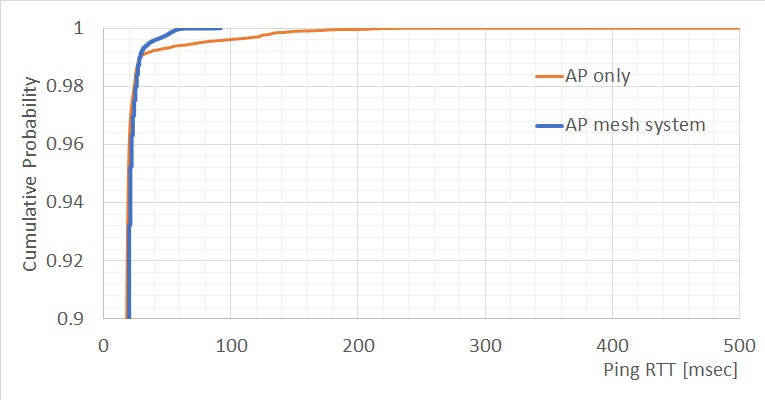
The results are very interesting when you zoom into the 99% percentile (0.99 cumulative probability) of the distribution. With the AP mesh system, the 1% worst-case latency is around 90 msec. This went beyond 500 msec for the AP-only scenario. These results interestingly are spot on to the findings in BITAG latency paper. A summary of the key highlights of the paper can be found here.
Working latency does not follow a normal distribution, but is instead often skewed or multi-modal. As a result, the mean and median are not informative. Rather, the 98th or 99th percentile of working latency is more useful in predicting the quality of experience [2]. “
Jitter measurement – 20 Mbps uplink, 24 hours measurement
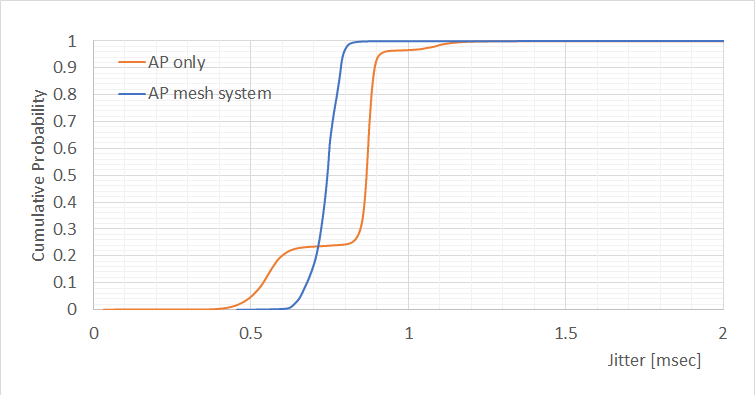
When looking at the 99% percentile (0.99 cumulative probability) of the jitter distribution, one can observe a 0.5 msec improvement in jitter with the AP mesh system. That means there is less probability of buffer overflows in a mesh AP system. This will cause fewer hiccups in a video/audio experience.
Packet loss-20 Mbps uplink, 24 hours measurement
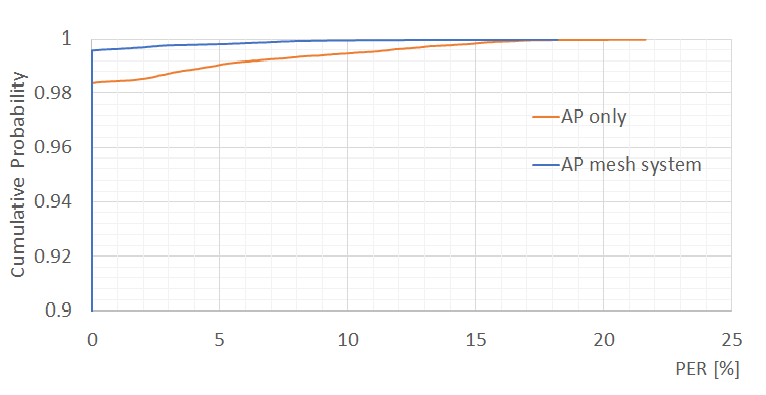
The packet loss distribution closely resembles the latency distribution, revealing that there is a direct correlation between packet loss and latency. Wi-Fi mesh AP systems led to an overall reduction in packet drops, thus leading to a lowering of latency.
These statistical distributions show how simply installing a Wi-Fi mesh system in our home improved our Wi-Fi connectivity experience. The Wi-Fi mesh APs lowered the 99 percentile latency spikes by improving the Wi-Fi link quality to our Wi-Fi devices!
Ok, this is all a bit technical. Magnus Olden from Domos was kind enough to run these measurement data through their cloud latency management solution. Here are the results
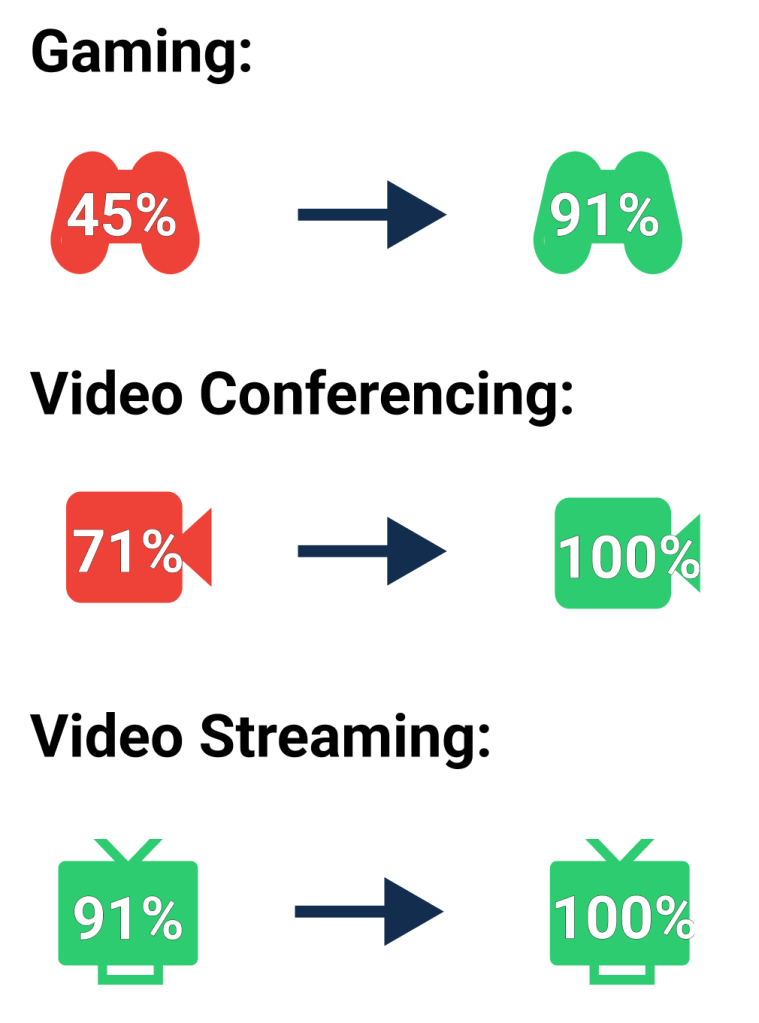
I can vouch for improvements in our Video conferencing experience with the Wi-Fi mesh system.

 Sarodeoverwireless Consulting
Leave a comment