The cable industry giants hold a commanding position in delivering internet, telephony, and video content to the residential/B2B customer base. DOCSIS and FTTH (GPON/XGSPON) are the dominant wired technologies that can deliver data rates of up to 10 Gbps downlink speeds to residential customers. This works well for the overserved market, i.e. upgrading existing customers living in cities and built-up areas, but for the underserved customers, i.e. people who don’t have access to broadband internet, are neglected and not part of the network upgrade plan due to poor Return On Investment (ROI).
With the increasing capacity, coverage of 5G/satellite communications; increase in work-from-home employees and the proliferation of Over the Top (OTT) video distribution platforms like Netflix/Disney, the cable industry must develop strategies to address the following concerns.
- Competition in the ‘underserved market’ from emerging network access technology over 5G (Fixed Wireless Access) and satellite networks
- Capacity vs Reliability – Customers want a reliable internet connection and industry network experts have found that higher capacity networks don’t necessarily improve the Quality of experience, lower latency networks do.
Let’s look at the innovation landscape presently being played out in the broadband industry through the lens of the framework developed by Prof Clayton Christensen
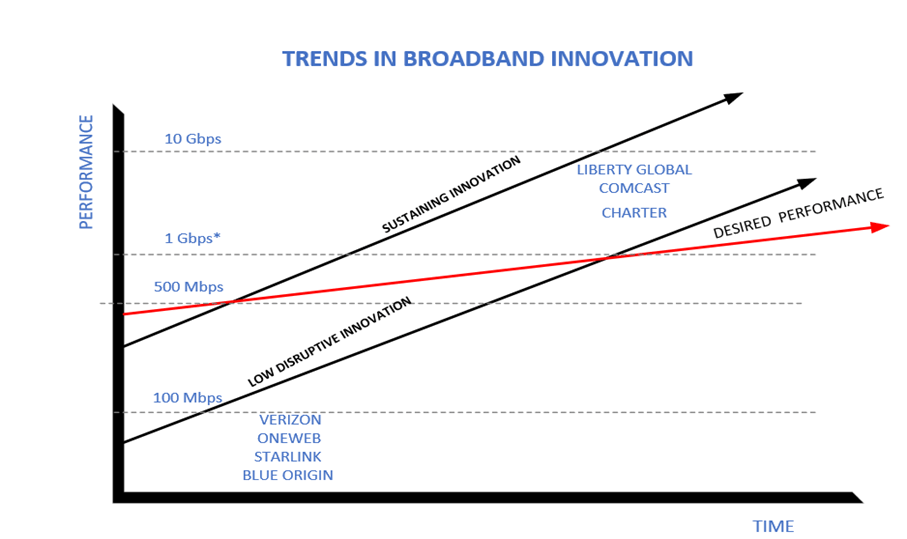
The cable industry’s core resources and processes are on the trajectory of sustaining innovation. It is developing 10 Gbps broadband data delivery technology over its existing cable infrastructure. Customers are being ‘overserved’ with faster internet speeds and access to multiple video streaming services. Competition from established incumbents and demand for higher performance services from its established customers is guiding the organization’s innovation roadmap. Its current and future offerings are addressing the ‘demand surplus’ which constitutes its current customer base and has limited scope to grow its subscriber base.
At the bottom of the broadband market is the large ‘underserved’ market segment. This large segment is the potential customers who have a legacy cable connection (DSL/ADSL); people living in rural areas/countryside in developed countries and the younger population who are mobile. These are also the underserved market for cable operators, whose cost models are a hindrance for broadband upgrades outside cities. Investing in upgrading Digital Subscriber Line (DSL) connections is not a cost-effective model for cable operators to retain their customer base. Fixed wireless access or satellite-based communication systems is the best choice for customers who don’t have access to high broadband speeds offered by cable operators.
With the advent of satellite-based internet service delivery, there is an opportunity for new entrants to disrupt the legacy cable operators. Companies like One web, SpaceX’s Starlink, and Amazon’s Blue Origin have developed broadband products by developing affordable satellite launch systems to space. As satellite delivery technology matures and becomes more than good enough for its customers’ data needs, it may become a threat to the growth of the cable industry.
Thus, my recommendation to cable operators is to partner/acquire MNOs which can help them speed up the deployment of fixed wireless access devices. MNOs have different cost structures, performance metrics, and customer bases and require a unique profit formula to be successful. The partner companies who are rolling out the FWA solution should be allowed to work within the processes and profit formula of the cable industry. Bundling Set-Top-Boxes (STB) with FWA solutions can be an interesting strategy to enter the low-end market.
Excited about how FWA and satellite broadband networks unfold and ”connects the unconnected”!

 Sarodeoverwireless Consulting
Leave a comment