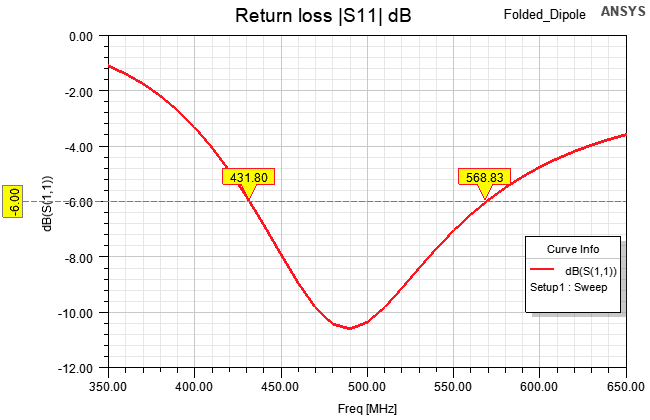
In this series of blogs, I would like to share my learning and experience in architecting various wireless-connected products such as IOT sensors, gsteways, Wi-Fi gateways and Smart voice assistants. RF architecture design is often one of the most fascinating yet challenging aspects of product design, where architects have to juggle many specifications to find the right tradeoff between performance and cost that suits the product manager’s requirements. Let’s start from the foundations and look at a simple RF specification called Return Loss.
Every active or passive RF component, such as antennas, filters, LNAs, and PAs, has an input and output return loss specification. It is a measure of how much of the incident power is reflected back to the source. Below is a simplified block diagram of an RF front end with an antenna. Note that each RF component has an input and output return loss specification.
The return loss specification is usually between 5 – 15 dB, and RF designers have to balance the trade-off between frequency, insertion loss, bandwidth, and output power to design this specification. The plot below shows the amount of reflected power (in percentage) with increasing return loss. Note the steep gradient of the decrease in reflected power per dB increase in return loss. A rule of thumb for Very High-Frequency (GHz) circuit design is to achieve a return loss below 10 dB so that only 10% of the incident power is reflected back. A poor deisgn with 5 dB return loss will lead to 30% of the RF power being reflected back, causing thermal and stability issues.
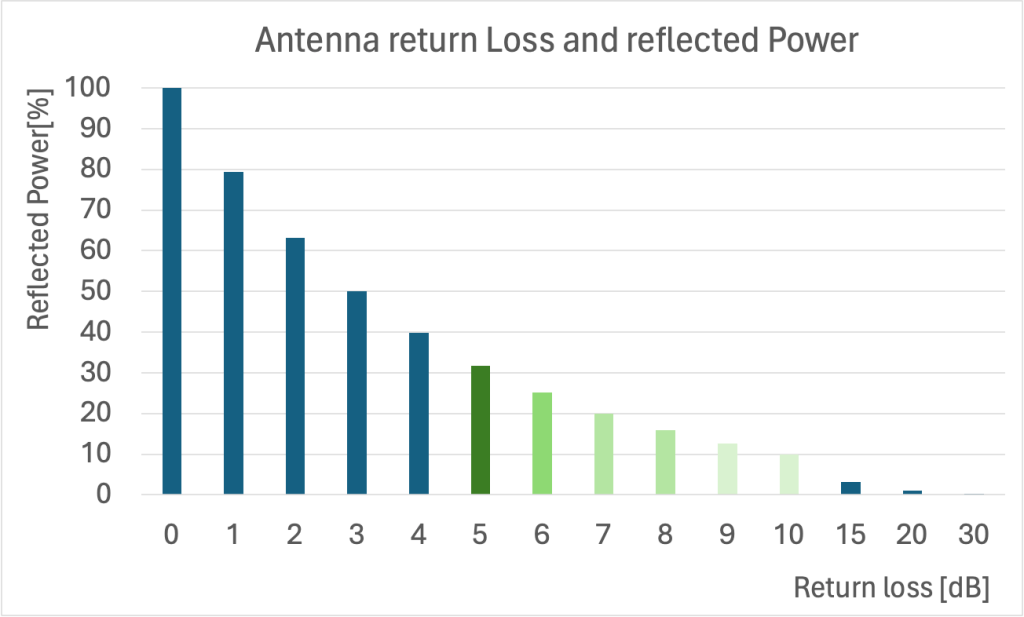
Poor return loss means the transceiver and Power amplifier (PA) in the chain have to pump in more power to compensate for the losses. It also means there are higher amplitudes of non-linear products as PAs are pushed into compression. The reflected signals also cause standing waves, which will lead to degradation in Error Vector Magnitude (EVM), noise addition, self-interference, signal distortion, and reduced system stability.
There are wireless devices that you just love and the ones that you regret buying. Building a strong foundation by making the optimum architecture choices and going ground up is crucial for the success of the product.
Are you struggling with RF issues for your wireless product design? Contact us to learn about solutions and services to help you build your next wireless product!
Mayur Sarode
Founder and Principal Technology Consultant
SARODEOVERWIRELESS Consulting

 Sarodeoverwireless Consulting
Leave a comment