
Wouldn’t it be great if you can get a second order estimate of the expected throughput of Wi-Fi7 technology? This can be done even before any investment in a wireless test campaign. Wireless performance tests are expensive, time consuming and cumbersome and are necessary once you get closer to your product form factor. Think about doing performance tests on Engineering Verification Test (EVT) and Device Verification Tests and Product Verification Test (PVT) phases. However, one can gain valuable insights into expected throughput benefits over previous Wi-Fi standards using theoretical modeling tools, long before starting your Wi-Fi7 product design journey.
In this blog, we will explore how theoretical modelling can be used to predict Wi-Fi 7 throughput and compare it against Wi-Fi5 and Wi-Fi6 technologies.
Why Theoretical Modeling?
Before diving into product development, understanding the expected performance of your Wi-Fi7 system can guide your design decisions and help optimize resource allocation. By using a theoretical throughput modelling tool, you can estimate key metrics such as range, rate, and overall throughput without the immediate need for physical testing.
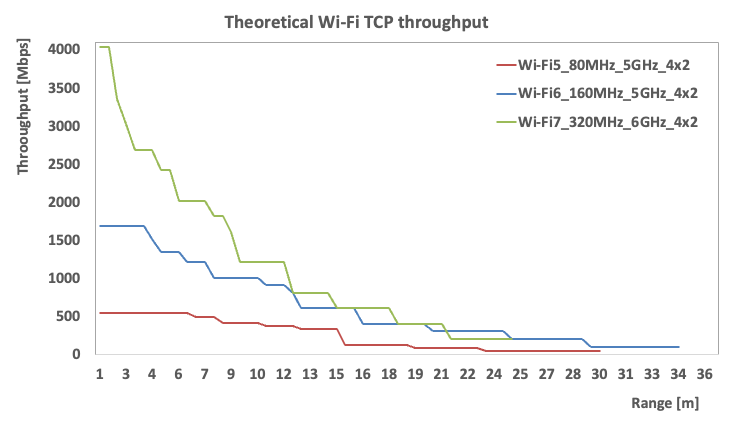
Below we will present a theoretical Range Vs Rate graph of Wi-Fi5, Wi-Fi6 and Wi-Fi7 technologies at their maximum bandwidth capabilities (i.e 80, 160 and 320 MHz) based on modelling following properties for Wi-Fi communication.
Key Properties for Wi-Fi Throughput Modeling
Wireless channel: 2 point breakpoint pathloss model, Rayleigh Fading margin
Building material: Attenuation caused by plastered walls and concrete floor.
RF : uncorrelated antenna gain, antenna losses. TX power@MCS index, receiver sensitivity@MCS index
PHY layer: TX beam-forming gain, Receiver antenna diversity, bandwidth, spatial streams
TCP/MAC overhead: 70% of PHY rate.
Range vs. Rate: Wi-Fi 5, Wi-Fi 6, and Wi-Fi 7
Throughput Improvement: With each generation of Wi-Fi, maximum throughput nearly triples. This significant improvement is primarily due to the doubling of bandwidth and the adoption of higher modulation schemes (Wi-Fi5: 256 QAM, Wi-Fi6: 1024 QAM, Wi-Fi7: 4096 QAM).
Short-Range Performance: Peak throughput is achievable at short ranges (less than 3 meters) due to the high Signal-to-Noise Ratio (SNR) requirements. However, the real advantage of Wi-Fi7 lies in its mid-range performance (4-10 meters), where it offers substantial throughput gains over previous standards.
Impact of Noise Floor: As bandwidth doubles, the noise floor increases by 3 dB. Interestingly, Wi-Fi6 with 160 MHz bandwidth provides better coverage than Wi-Fi5 with 80 MHz bandwidth, thanks to the smaller OFDM channels utilized in Wi-Fi6. This concept was discussed in detail in a previous blog.
Theoretical modeling offers an opportunity to estimate the expected throughput of Wi-Fi 7 before committing to costly and time-intensive testing. By understanding these theoretical performance metrics, you can make more informed design choices and optimize your Wi-Fi7 product development process.
Are you interested in more insights on the throughput and coverage benefits of Wi-Fi7 for your upcoming product? Contact us today to learn more and discuss how our expertise can support your Wi-Fi design journey.

 Sarodeoverwireless Consulting
Leave a comment